All the world's a stage for Progress Theatre — literally. In 2008, they will join an elite number of theatre companies from around the world on tour as part of the World Music Theatre Festival in Europe. Called "the next wave of aesthetics in words" by the San Francisco Chronicle, this six-year-old touring ensemble of "twenty-somethings" has performed at theatres, festivals and universities around the country. With their original musical plays that join contemporary aesthetics with the essence of Black theatre's rich legacy, they are at the forefront of the next generation of Black theatre. Their past performances boast sold-out engagements at the world famous Apollo Theatre, and season slots at the Kennedy Center in Washington DC, the National Black Theatre Festival, the Yerba Buena Center for the Arts in San Francisco, where I first saw them, and many more.
"Our art is really about enacting change, not how good we sing or act, not how much money we make, where we perform, if we'll ever be 'famous'… all of those things that at the end of the day really don't matter," asserts Dana Bowles, a founding member. "Our passion for social change and creating dialogues about the issues that affect our communities keeps us humble and aggressive about continuing what we do, and driven to reach more and more people." But, don't even begin to assume that their mission of social change means you'll be in for an evening of preachy dialogue. "Theatre with a message doesn't mean you're not going to have a good time," says member Aaron Goodson. In fact, Progress Theatre (PT) shows are high-caliber art — so creative, complex and relevant that before you know it you've experienced all the emotions that can bring laughter and tears, and you can't wait for more. "Some of my favorite memories are experiencing the reactions of audience members who have preconceived notions about our work. It's a mixture of surprise and fulfillment," says founding member Maiesha McQueen. "I think that many of them walk away with a new perspective on the experience that they can have with progressive art."
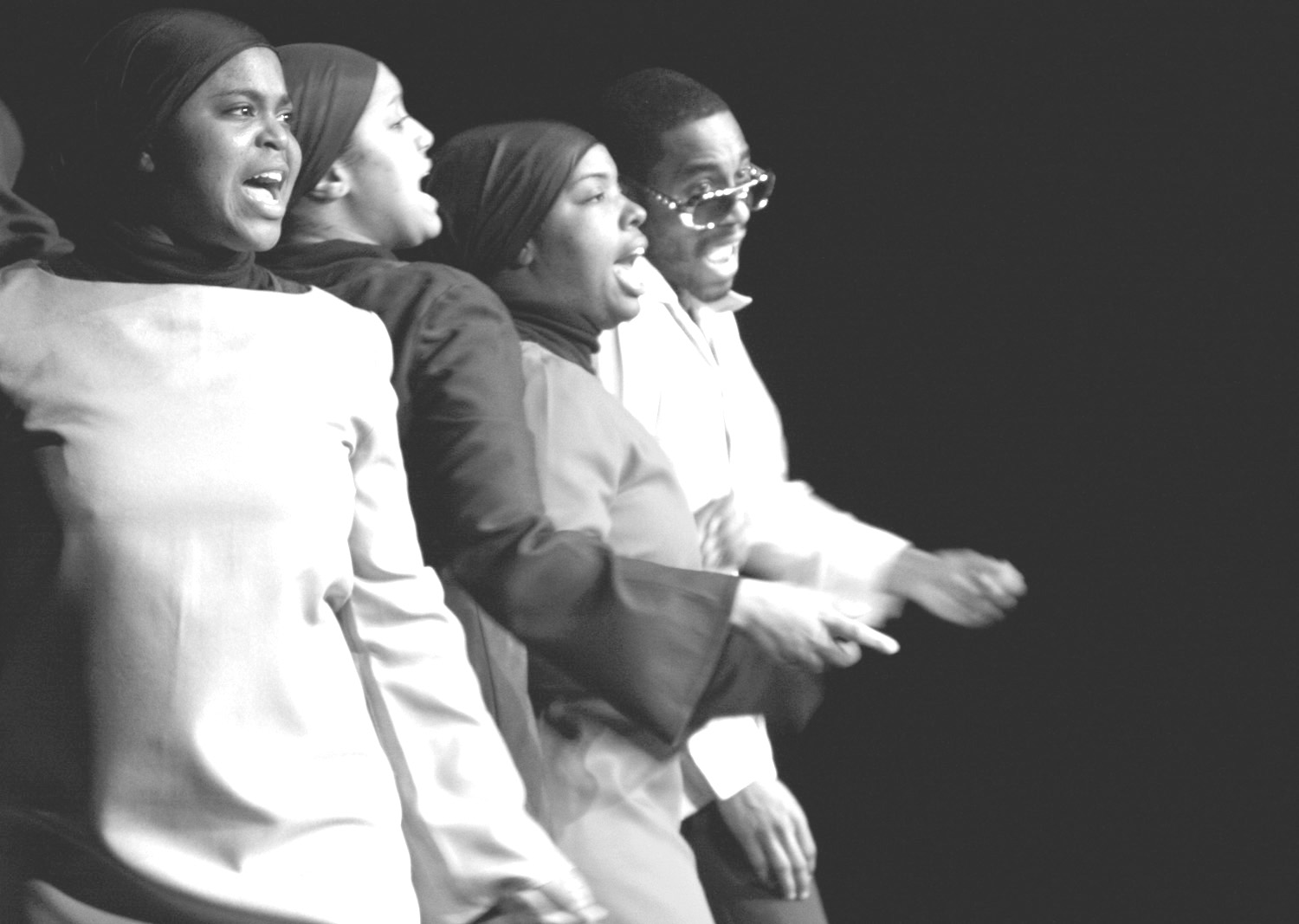
In true ensemble theatre form, Progress Theatre is a one-stop shop of talent, creativity and artistic innovation. Playwright and founder Cristal Chanelle Truscott — whose writing the December 19, 2001 edition of New York Show Business Weekly describes as "astonishingly vivid" — conceives and pens the company's original pieces packed with amazing stories and unforgettable characters. Music composer Maiesha McQueen adds the musical score that ranges from Negro spirituals to blues, jazz and R&B in what the Weekly terms "elaborate, daredevil" four-part harmony. Actors Dana Bowles and Aaron Goodson complete the ensemble and as a unit the acting and vocal prowess of these four delivers a repertoire where any piece on any given day captivates, challenges and inspires.
Highlighting their repertorial nature, Truscott asserts, "I think being a touring, reportorial theatre company makes us unique because our audiences not only come to see a particular play but to see Progress Theatre as a whole. You see that with music ensembles or dance companies. Touring dance companies are able to perform several pieces in their choreographer's repertoire at a moment's notice. Even though people know Alvin Ailey's Revelations, they rarely say, 'I'm going to see Revelations.' They say, 'I'm going to see Ailey,'" explains Truscott. "But in theatre, it's usually plays that tour, not companies. Progress Theatre differs in that we tour our body of work, our company, our mission. Some theatres will book us to do two different shows in one weekend. Our repertoire lives in our bodies like choreography lives with dancers. We can perform any given PT show at a moment's notice."
To boot, the members of the ensemble have a collective array of impressive academic degrees including four Bachelors of Fine Arts in Theatre from New York University, two Masters in Education and one pending Ph.D! Three of the performer/creators were also Africana Studies double majors. And if Progress Theatre's resume isn't already impressive enough, consider this: while many regional Black theatres struggle with low season-ticket sales and lackluster interest by today's young adult generation, Progress Theatre is succeeding in bridging the generation gap and building consistent audiences of supporters across the country. "It's easy to tell a Progress Theatre show, because you get all the generations. And people stick around talking, laughing, even crying," says Atlanta theatregoer Leila Jackson, who discovered the company when seeing another show. "I was on my way to the bathroom and curiosity made me stop and see what show this was because their audience filled the lobby and I had never seen so many young, Black people at a play." Progress Theatre fan Marc Stevens, a high school teacher in Baltimore, sheds light on the enthusiasm that makes Progress Theatre audiences linger. "After the show I was thoroughly moved and revved up!" he explains. Goodson, the sole male performer and a former audience member himself before he joined the company, agrees. Having been on the receiving end of these powerful pieces, he notes, "Progress Theatre shows inspire audiences to engage and continue dialogue even after they leave the theatre."
Seeing Progress Theatre now, going full-steam ahead into 2007, you'd think they'd planned it all from the start. But, the birth of PT actually began with much simpler aspirations: ditching college. In the spring semester of 2000, Truscott decided to withdraw from her theatre classes at New York University's Tisch School of the Arts. She had no interest in auditioning for the school productions or joining the race to make a "big break" into show business. "I was more concerned with what I could do to be of assistance toward positive change in the world," she recalls. "In college, knowledge and life lessons can come at a fast pace and, for me, that time brought on a fresh awareness of history, of Blackness, of womanhood, of injustice…of the world and [my] place in it."
She had written a play, and her proposal to mount it as an independent production that would fulfill the remaining theatre credits she needed to graduate was approved by the Department of Drama. She called the play PEACHES. "It's not autobiographical, but it certainly embodies the energy of fresh awareness I felt at that time. But, I think PEACHES had been brewing since I was fifteen, when I first heard Nina Simone's song 'Four Women.' Even then, I was fascinated by the social effects of stereotypes, of the way I was stereotyped as a Black, female, young person. I had experienced what it was like to be instantly labeled 'angry' or as having 'attitude' before you even spoke. So, when I heard her yell 'Peaches!' at the end of the song, I knew I would write something someday about who I understood 'Peaches' to be."
The PEACHES she finally created is a tour-de-force to say the least. Baltimore City Paper says, "Truscott's PEACHES grabs at clichés of black womanhood, deconstructs them…and by the end of this high-energy presentation, gets them to march to their own drummer" (October 12, 2005). PEACHES traces a timeline from slavery to the present day weaving music, theatre, movement and social commentary into a rich, exploration of African American female identity that confronts the longstanding stereotype of the 'angry' Black woman.
Script in tow, Cristal Truscott set out to find actors. "Tisch Drama was big on colorblind casting, which isn't a bad thing per se, but the department definitely pushed that culture in school productions. I found that many of my peers were reticent about doing race-specific work. I thought, 'How am I going to find Black actors at NYU who are not on the fame track and who wouldn't shy away from being in an all-Black cast and from doing work that could bring up hard conversations about race on our campus.'" Instead of holding auditions, she asked around. "Right away, two or three folks said to me, 'Do you know Maiesha McQueen?'"
Truscott and McQueen realized early on that they were destined to be a creative team. "We call it our 'love story,'" both women tell me in separate interviews. McQueen adds, "We didn't really know each other well before I was cast in the production, but we just clicked. We call it our 'love story,' because it wasn't just about me doing her play, but us discovering that we shared a spiritual and artistic vision."
"She has an amazing voice," says Truscott, "but what's more is that she sings with an emotional sincerity that takes you on whatever journey she's on." Their collaboration was instantaneous. "Maiesha began to lay harmony on the spirituals at that first meeting. As rehearsals continued, I would say, 'I know there's a song here,' and then have some really abstract way of describing what I was looking for. And she would say, 'I get it. I can write something.' And what she would write would fit perfectly."
Their unspoken connection remains today as they continuously tour and create new work for Progress Theatre's repertoire. "We are constantly collaborating," says McQueen. "I love Cristal's talent. I love working with her because I can't do what she does and I'm inspired by that. I am inspired by her words."
When PEACHES premiered at NYU's Experimental Theatre Wing studio, the response was overwhelming. "The first show was maybe two-thirds full," Truscott remembers. "Every show thereafter was sold-out — students, professors, civilians who just heard about the show. We even added extra shows up to the minute that we had to give over the theatre to the next show. Folks were practically sitting on the stage," she laughs. "But, it was clear that our work was touching on things that people were bursting to talk about. And that's what made it a success to us."
What they didn't know was that after seeing PEACHES, several of their professors invited well-known New York theatre producers to see the show. By the time Truscott graduated in 2001, the play had received a grant from the National Performance Network and was booked through the Fall with performances at PS 122 in New York City, New WORLD Theatre in Massachusetts and the National Black Theatre Festival (NBTF) in North Carolina. "Beth Turner was the catalyst for getting us into NBTF. We had all taken her classes and she had been a great support to each of us at NYU. When she saw PEACHES, she suggested NBTF, wrote us a letter of recommendation and was there in North Carolina when we performed that summer. To this day, if she is around when we're doing a show, she's there and with friends. I think she's seen us perform in about three different cities. We really couldn't have asked for a better mentor and supporter."
PEACHES is now known as Progress Theatre's signature and most highly acclaimed piece. It is set to be published by the prestigious Theatre Communications Group later in 2007. Also, the show has not stopped touring since 2001 and ultimately spawned what is now Progress Theatre. "PT was not planned; it all came about very organically fueled by our joint passion to do meaningful work," says Truscott. McQueen agrees. "When Cristal came to me about starting a company, I felt like it was truly meant to be." Truscott elaborates, "I always loved the idea of an ensemble and longtime artistic partnerships. Maiesha and I knew that we wanted to collaborate on more new works. So at the very least, we knew we were in it together. Once Dana and Aaron joined the company, it felt like the ensemble was complete. It still seems meant to be." Goodson agrees, saying "We are definitely held together by our love for each other and our love for this work — and our commitment to striving both artistically and spiritually."
Today Progress Theatre's touring repertoire includes PEACHES; their second work 'MEMBUH: Confessions of The Only Generation, which includes a retelling of the founding of Juneteenth; The Rain, a third full-length work-in-progress; several shorter pieces; and a musical soundtrack all their own. In addition to touring, PT manages two community outreach programs: The Open Stage, a pre-show segment highlighting upcoming and veteran artists of different genres in each city on their tour; and Generation Progress, a youth arts education program offering workshops, special low-cost performances and post-show discussions. "Young girls after the show are so emotionally filled and thank us for saying everything they have wanted to say. They just start talking about changes they are now inspired to make in their lives. It is how I felt when I first read the plays, and I think a lot of people feel like that," comments Dana Bowles.
The company also plays an active role in audience development with theatres that present them. "Early on, depending on where we were, our audiences might be lacking diversity, not just racially, but culturally and also in terms of diverse spiritual communities, age groups, financial brackets and so on," Truscott explains. "Part of our outreach has always been to bring in people who theatres would not typically market to or people who may not typically go to the theatre."
While Progress Theatre audiences pack theatres around the country and their following continually grows, the company admits that bringing in diverse audiences is a tough task. "Because people may not always be familiar with us and what we do, a lot of times they are skeptical to come and 'see a play,' not knowing that their experience will be a lot larger than that. People also expect very little from us a lot of times because we are young and Black," says Bowles. "I can't tell you the amount of times someone has come up after a show and said, 'I didn't expect it to be this good.' And, it's like why not? Because you have never heard of us? Because we are young? Why? But, we always say that once someone sees one show, we have a fan for life because that's been the way it has worked so far."
Progress Theatre's outreach bears impressive fruit, evidenced by the steady demands on their tour schedule for engagements even outside of traditional theatre settings. Not only have they the support and interest of some of the most respected theatre houses as a professional artistic ensemble, but their versatility and hands-on connections with communities also has led to bookings at libraries, museums, universities, poetry cafes, fundraisers, radio stations, conferences, panels and in college classrooms. "We've gotten to travel and have so many unique experiences. I really could not have imagined the blessings and the road of Progress Theatre to this point," says Truscott. And this tight-knit company shows no signs of slowing down. "Well, you only slow down," Truscott asserts, "once you feel like you've reached your goal or that one ideal that you've been reaching for all along. But, the intention of Progress Theatre has never been to reach a particular venue, get a certain award, and obtain this or that degree of recognition. Our intention is to use our art toward…healing, understanding and positive change in our times. This means that we've no time to slow down, because the canvas of work to be done is inexhaustible."