
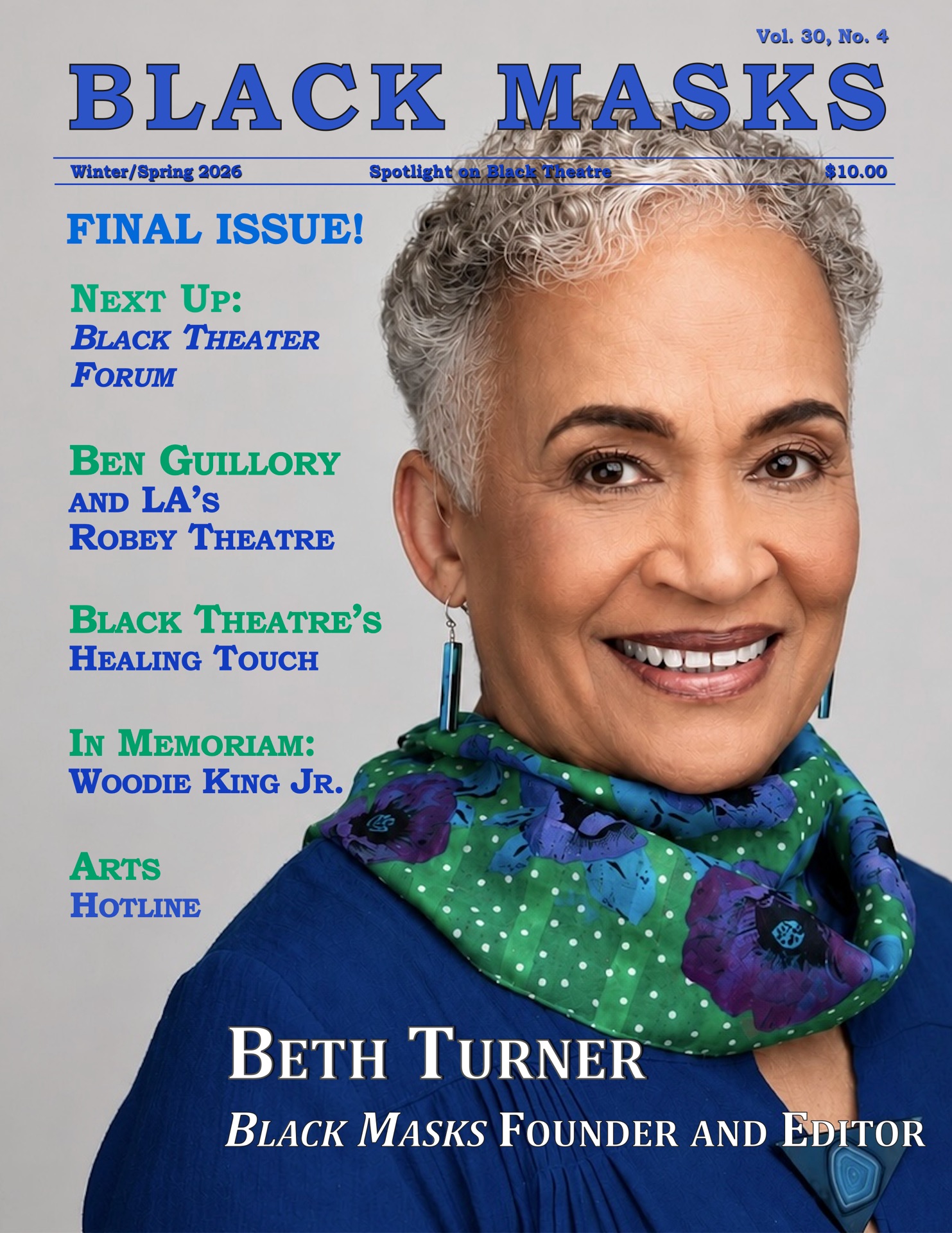
I would not dare provide a summary of August Wilson's Joe Turner's Come and Gone, the third of the Broadway-produced plays in his American Century Cycle. To do so would be nothing short of an insult to Black Masks' astute readers. Instead, I offer a reminder that the play has been described and praised in numerous ways, but undeniably, it is a narrative of people on their way somewhere trying to "find their song," their sense of self and belonging. But first of all, they must pass through Seth and Bertha Holly's boardinghouse, and in Seth's words: "This is a respectable house" (Wilson 5), that is, a safe space for Black Southern migrants traveling with their stories and struggles, engulfing them in community and hope. Similarly, Black Masks has been a respectable, safe space where Black theatre and artists could share their stories, struggles, and successes, for nearly forty-two years, under the vision and leadership of founder and executive editor, Beth Turner.
Unlike Seth Holly, who just dreamed of opening a shop to teach young Black men his craft, Beth Turner, in 1984, undertook the "opening" of Black Masks, the only Black theatre magazine, to this day, dedicated to recognizing Black theatre. Turner recalls, "My first six-page issue featured Woodie King Jr., and I almost wonder how I had the nerve to present it to the Black theatre community at the opening session of the 1984 Frank Silvera Writers Workshop. We, in Black theatre, were starving for print. Black playwrights, actors, directors, and producers created work, season after season without any print or video documentation of the performances and with little publication of our playwrights' dramatic texts. The work of our generation of Black artists was fading into oblivion." At that time, Turner, a playwright herself (more about her plays later), wife, and working mother of two children, decided to bring Black theatre into the light. But those first days were challenging.
When asked to describe those early pre-computer publishing days for Black Masks, Turner laughs out loud, "I really don't know how I did it. It was all about layouts. It was laying out borders with thin strips of graphic tape. It was laying out copy that I had typed using typographical code…
To finish reading this article, purchase this issue today.
Get this cover story and the rest of the Final Issue (Vol. 30, No. 4) for only $10.
Order the Final Issue